Don'ts During The Excursion
| Rubbish like papers, plastic, cans should not be thrown during the excursion. Do not pull up plants and do not take animals home. Do not damage private property that you cross. In Springtime, when the birds make their nests, do not walk where you can disturb them. If you drive a car o ar motorbike, go slowly. You must make as little noise as possible, respecting the quietude of the environment. Do not park on the vegetation or the dunes. Fire-making is not allowed. |
| The best season to walk this path is the spring. But because of the mild climate of Oliva, any moment is good to discover a wide range of plants and animals. | 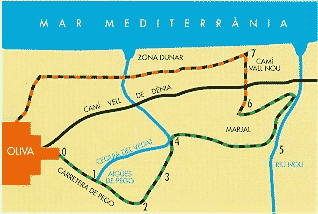 |
| A view to marsh | LA MARJAL |
|---|---|
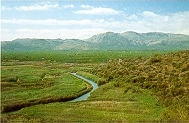  |
The marsh is a humid area, almost plain, with temporarily floods because of hight level of the subterranean waters. |
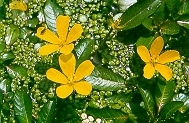
| The waters from Pego | ULLAL |
|---|---|
A "Ullal" is a source of subterranean water proceeding from the mountains, wich springs near by the calcareous relieves and the coast plain (wich is made by clay, sand and gravel). It is a little round pool of clean waters. |
 |
| Bullent river | Calapatar |
|---|---|
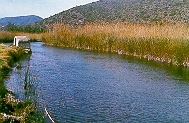 |
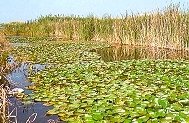
After having followed the riverside of the Bullent, we will arrive at a point where we can see, for the first time, the river bed which has widened. Here we can walk across it and reach some old ruins. Around these, if we scratch between the reeds we will find in a lot of pools of water, the "ullals". Inside we can observe apart of thousand of snils, an endemic fisch called "samaruc", almost extinguished. So it is a stop with a big ecologic interest, where we can see how the land of the marsh fights with its neighbouring mountains of stones. |
If you are not to tired to go and if you dare to cross the narrow bridge or "Para de Sant Pere" you will reach the old sluice gates of the irrigation chanel which was used to regularize the entrance of water to the marsh when the rice was produced here. |
 |
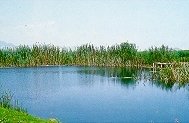 |
The path to the bridge of Sant Pere leads by the Sant Pere Hermitage. Following the track of the bridge called La Llosa, we will reach the Bovar Valley which will be all the away at the side of the itinerary that we have to walk until a ravine. It is considered as the general dranaige of the marsh Oliva-Pego. Here we can see how the frogs escape and hide from the water vipers. We can gaze at the sport flying of the water pullet or the majestic once of the royal heron ant the acrobatics of the white stork and "archibebes". Look at the shiny grebes going away meanwhile the herons fly around our heads. If you want to see more and are patient you could gaze at the royal heron or the rare basket bird. Finally we reach the pool called "Bassa del Sineu" crossed by an old bridge which has well resisted the dampness. A little further, under the bridge, the water lilies join the river Nou or Racons. |
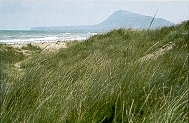
In all the sandy beaches, you can see a first area where the wawes and the tides wet the sand and leave naturally organic deposits. Some plants which resist to the salt can profit by those deposits to form thier communities. Between the sand that has been wet by the wawes and the high dunes, you can find smaller ones. The sand blown by the wind sticks to any obstacle like shells or small stones forming those first dunes. |
 |
Passeig Lluís Vives (Parc l'Estació) s/n
46780Oliva
(96)2855528 - Fax: (96)2839772
http:\\www.tourist-oliva.com
